
Case Study · Custom Metalwork
The Photo Most Fabricators Would Not Bother Taking.
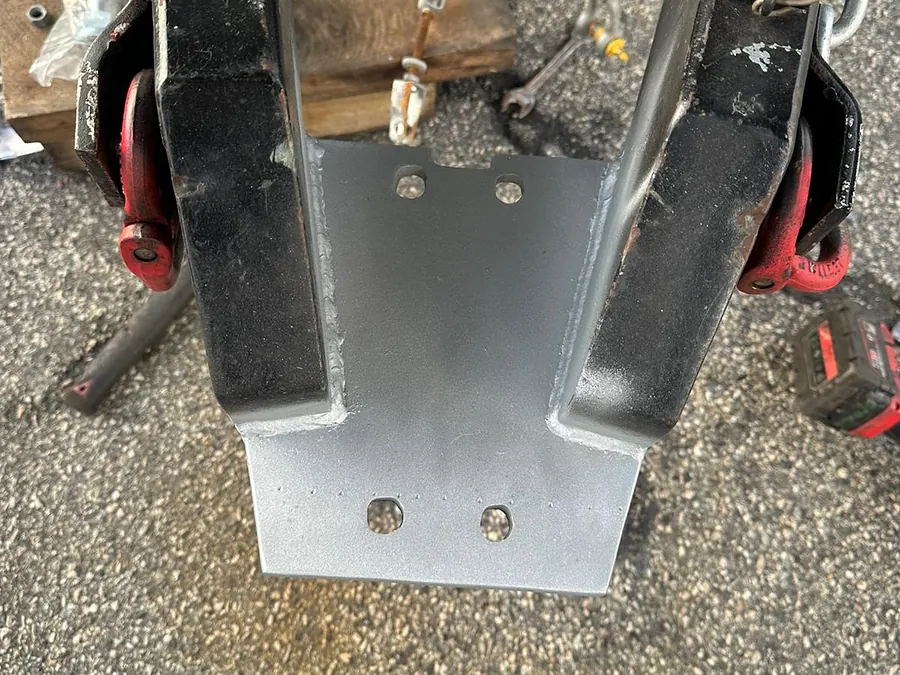
Our own photograph, taken part-way through making the thing: clamps still on, welds still bright, nothing cleaned up for the camera.
What You Are Looking At
The photograph, described.
A steel base plate welded in between the two legs of a fabricated frame, photographed from directly above on the hardstand. The legs are painted black; the plate is still bare steel. Fillet welds run down both sides of the plate where it meets each leg. Four holes are drilled through it, a pair up near the throat and a pair in the foot, and the plate is not a plain rectangle: it widens at the bottom so those lower two holes sit clear of the legs.
The red clamps are the reason this photograph is worth showing. They are still holding the plate square to both legs, which is the state the job is in for the few minutes that decide whether the finished frame is true. Once the welds have gone down and cooled, that geometry is what you have got.
The Trade In It
What A Connection Like This Takes.
Set up first, weld second
Clamped, checked and only then welded. Everything you can fix with a clamp in thirty seconds becomes a cutting-and-rewelding job once the steel has cooled out of square.
A base plate is a load path
Whatever the frame carries goes through those welds and those four holes and into whatever it is bolted to. There is no decorative weld on a connection like this. The run down each side is doing the work.
The holes have to suit something else
Fixing holes are not free-hand. They are set out to match the fixings and the thing the frame bolts to, and the plate is shaped around them, which is why its foot is wider than its throat.
Bare steel is a stage, not a finish
The plate is unpainted in this photograph because the frame is not finished in it. What coating it ended up with is listed below, once the client confirms it. We are not going to tell you it was hot-dip galvanised because it would read well.
The services behind this job
The facts strip below is deliberately part-empty, and one gap in it matters more than the rest: this frame's purpose and any rated capacity. That is a safety claim, so it stays blank until the client puts it in writing.
Project detail
-
Sector
Custom Metalwork
-
Steelwork
Welded and drilled plate joining the two drawbar members of a custom trailer hitch
-
Stage
Photographed mid-fabrication, welding clamps still fitted
Next Step
Ready to get a number on your project?
Send the details through and we'll come back with a written quote and a realistic timeframe.